Trends in the tribunal · 1
ADHD and autism in the tribunal
How often ADHD and autism are relied on as disabilities in Employment Tribunal claims, how often respondents concede them, and how often tribunals find they meet the statutory test.
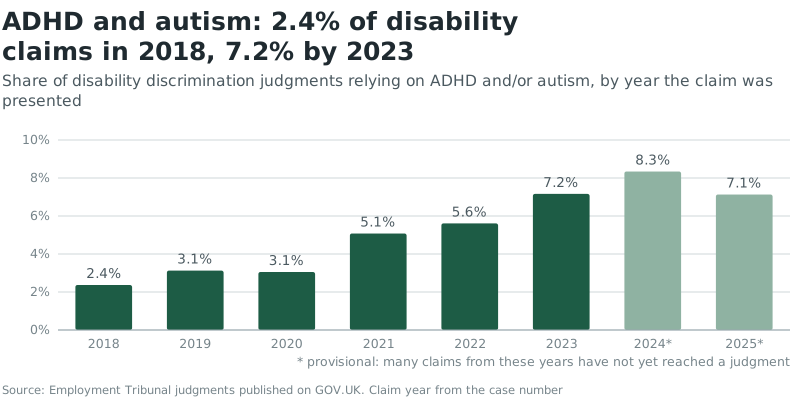
ADHD and autism have become a regular feature of employment work over the last few years. They come up in grievances, in requests for reasonable adjustments and, increasingly, in tribunal claims.
The published judgments show how the tribunal deals with ADHD and autism when they are relied on as a disability. How often are they relied on? How often do they meet the statutory definition, and how does that compare with other mental impairments?
To answer those questions I looked at the 12,857 readable disability discrimination judgments in the published register. The figures are grouped by the year the claim was presented.
The definition
Under section 6 of the Equality Act 2010, a person is disabled if they have a physical or mental impairment that has a substantial and long-term adverse effect on their ability to carry out normal day-to-day activities. Schedule 1 fills in the detail, including what “long-term” means and the rule that the effect of treatment is disregarded. The burden of proving disability is on the claimant.
The Act doesn’t require a diagnosis. Equally, a diagnosis doesn’t settle the question, and tribunals can and do find that someone has ADHD or autism without finding that they are disabled.
What impairments are relied on
| Impairment | Share of disability judgments |
|---|---|
| Depression | 16.4% |
| Anxiety | 15.5% |
| Back / musculoskeletal | 6.6% |
| Dyslexia / dyspraxia / dyscalculia | 3.7% |
| Stress-related conditions | 3.6% |
| PTSD | 3.5% |
| Autism | 2.9% |
| Arthritis | 2.4% |
| ADHD | 2.3% |
A judgment can rely on more than one impairment, so the shares don’t add up to 100%.
Depression and anxiety are by some way the most common, relied on in 16% and 15% of disability judgments. They are the natural point of comparison for ADHD and autism, which are looked at next.
How often ADHD and autism are relied on
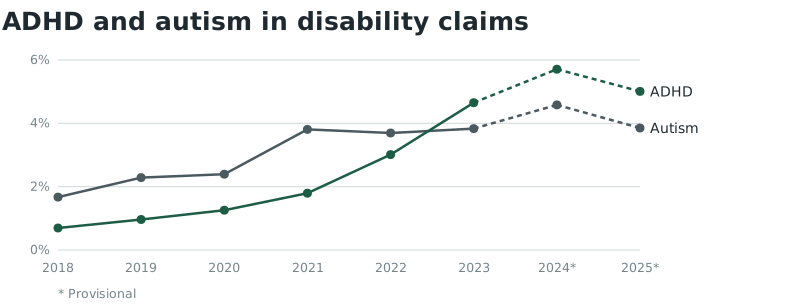
ADHD and autism relied on as a disability, as a share of disability discrimination judgments, by year claim presented. 2024 and 2025 are provisional.
Between 2018 and 2023 the share of disability judgments relying on ADHD and/or autism trebled. Since 2021 they have been the fourth most commonly relied on impairment, behind anxiety, depression and back or musculoskeletal conditions, and the third for 2024 and 2025 claims (provisional). Those later figures suggest the rise hasn’t levelled off.
Most of the growth comes from ADHD. It rose from 0.7% of disability judgments for 2018 claims to 5.7% for 2024 claims (provisional), and on its own it has risen to third for 2025 claims (provisional). Autism grew more slowly over the same period, from 1.7% to 4.6%.
How often ADHD and autism meet the definition of disability
For claims presented between 2018 and 2021, ADHD and autism met the definition of disability in 93% of the cases where the question was dealt with. For claims presented since 2022, the figure is 83%, so about one in six now fails.
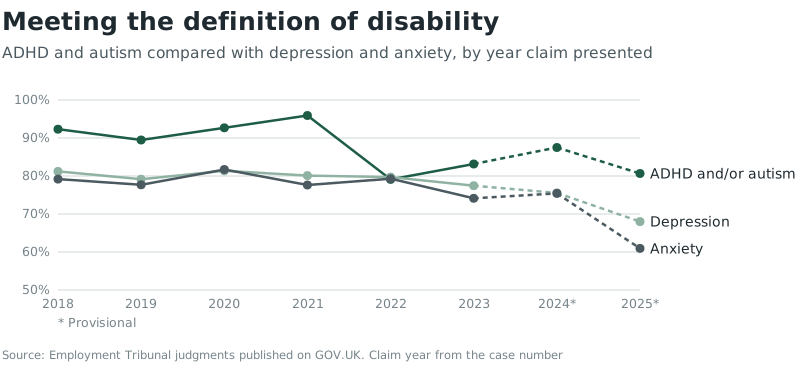
How often the impairment met the definition, where it was conceded or decided, by year claim presented.
That change doesn’t mean ADHD and autism have become a weaker basis for disability. They are simply no longer accepted almost automatically.
When the respondent disputes it
Respondents are conceding disability less often generally, and ADHD and autism are no exception. They were conceded in 72% of claims presented between 2018 and 2021, falling to 57% for claims presented since 2022. That is still higher than for depression (46%) and anxiety (43%) over the same period.
When a respondent does dispute ADHD or autism, claimants now lose the point more often. For claims presented between 2018 and 2021, the tribunal found the claimant was not disabled in 26% of disputed cases. For claims presented since 2022 the figure is 38%.
How tribunals approach the evidence
Whether the claimant has a diagnosis, and can prove it, makes more difference than anything else. Looking at the cases where the respondent disputed disability, ADHD and autism met the definition in 82% of cases (82 of 100) where the claimant had a diagnosis made in adulthood and supported by medical evidence. Where the claimant was self-identifying, awaiting assessment or relying on a diagnosis they couldn’t evidence, the figure was 23% (14 of 61).
A diagnosis settles whether there is an impairment, but not whether its effects are enough. In none of the cases with an evidenced adult diagnosis did the tribunal find that the impairment hadn’t been made out. Where those claims failed, 18 findings in all, it was on the effects: in 11 the effect wasn’t substantial, and in seven no adverse effect on normal day-to-day activities was shown.
A childhood diagnosis without current evidence is less secure. In Selby v RAC Motoring Services and Anderson v P J Carey Contractors, both ADHD cases, the claimant relied on a diagnosis made as a child and the tribunal wasn’t satisfied that the condition was present at the material time. In Anderson the tribunal observed that, while some people diagnosed with ADHD in childhood continue to have it as adults, that isn’t always so, and there was no medical evidence that the claimant had it when the events took place. That reflects the medical research, which finds that ADHD symptoms often fluctuate over time, and that few people diagnosed as children stop meeting the diagnostic criteria altogether.
Without a diagnosis, tribunals look closely at what the medical evidence does show. In Scaife v EUI Ltd and Harrison v City Plumbing Supplies Holdings Ltd, there was no diagnosis of autism and no reliable evidence of a substantial adverse effect, and the claim to be disabled failed.
A tribunal can’t diagnose ADHD itself, but a missing diagnosis doesn’t always defeat the claimant. In some cases the tribunal found the claimant disabled on the impairment the medical evidence did establish. In Thompson v Local Works Ltd, the claimant relied on ADHD without a diagnosis, and the tribunal found her disabled by depression and anxiety instead. In Amono v AS Watson Health and Beauty UK Ltd, the tribunal didn’t accept ADHD, but found disability on weaknesses in working memory, phonological processing and reading comprehension. In Rhodes v Royal Mail Group Ltd, the claimant relied on ADHD, but he hadn’t been diagnosed and was still awaiting assessment, and his GP records suggested several possible explanations for his difficulties. Following J v DLA Piper UK LLP [2010] ICR 1052, the tribunal found from the effects on his concentration and organisation that he had a mental impairment meeting the definition of disability, although it couldn’t say what that impairment was. ADHD was the only condition he relied on, but the tribunal gave him the benefit of the doubt and treated him as disabled by an undetermined mental impairment.
What has changed
ADHD and autism have moved from being rarely relied on, and almost always conceded, to being among the most common impairments in disability claims. As their numbers have grown, they have become part of ordinary disability litigation: respondents dispute them more often, and they no longer meet the definition almost automatically.
What sets them apart is where the argument lies. For ADHD and autism, the question is often whether the impairment has been shown at all, and the answer depends heavily on the medical evidence. An evidenced adult diagnosis makes a substantial difference. Where there isn’t one, tribunals won’t fill the gap themselves, but they will look at what the evidence does establish, and that is sometimes enough.