Valuing injury to feelings · 1
Injury to feelings: building the awards database
How injury to feelings awards were extracted from every published Employment Tribunal judgment, using a pattern-matching pass, a language model running locally, and checks of every figure against the text of the judgment.
Injury to feelings awards were one of the areas that first drew me to this project.
An award for injury to feelings forms part of the compensation made when a claim for discrimination succeeds, and in some other limited circumstances, such as whistleblowing detriment. It is also one of the most misunderstood parts of a claim, and is almost always the reason a claimant’s expectations can run well beyond the realistic financial value of a claim.
There are understandable reasons for that. Discrimination is a deeply personal experience, and for the person on the receiving end it can feel serious and lasting in a way that is hard to put a figure on. Many claimants start from the position that a claim for discrimination must be worth tens of thousands of pounds, because of how it felt to be treated that way. It can be difficult to accept that conduct which led to months off work may be worth relatively little in lost earnings, because their contract maintained their pay during the absence.
That often leaves injury to feelings to carry, in monetary terms, the claimant’s whole sense of injustice. In practice, explaining to a client that the treatment they received does not fall within the top band, let alone above it, can be a difficult conversation.
Explaining the bands is not straightforward either. Vento describes the lower band as being for less serious cases, such as an isolated or one-off act, though what makes an act less serious is rarely self-evident. The middle band covers serious cases that do not merit the top band, often involving conduct over a longer period, although a single act can itself be serious enough to fall there. The top band is for the most serious cases, and the example Vento gives is a lengthy campaign of discriminatory harassment on the ground of sex or race. That raises the question of why those forms of harassment should be singled out. Whether awards in practice differ between characteristics is one of the questions examined later in the series.
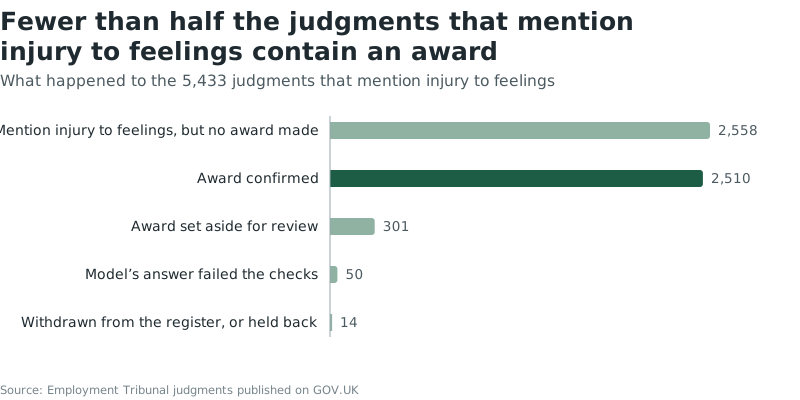
Resources such as Lexis, Practical Law and Harvey provide examples of cases in each band, but they are selected cases. The published register holds thousands of awards, but the register itself does not record them. This article describes how they were extracted from the 134,000 judgments described earlier in the series, and how each figure was checked. The first step narrows the field considerably: only 5,433 judgments mention injury to feelings at all, and fewer than half of those record an award.
The approach in outline
The work was done in four stages. Each was given to the method best suited to it: pattern-matching to find candidates, a language model to read them, and ordinary code for arithmetic and checking.
| Stage | What it does | Result |
|---|---|---|
| 1. Pattern pass | Finds every judgment that mentions injury to feelings | 5,433 of 134,437 judgments |
| 2. Model pass | A local language model reads each one and decides whether the tribunal made an award | 2,875 identified as awards |
| 3. Verification | Each figure is checked against the judgment; doubtful results are set aside for review | 2,825 pass the checks, of which 301 are set aside for review |
| 4. Reasons pass | A second reading identifies the factors that set the level of each award | A short statement of reasons, where the judgment gives one |
Stage 1: the pattern pass
The first script reads every judgment in the collection and builds an index of each one: case number, claim year, parties, the protected characteristics mentioned, other claims, whether it appears to be a remedy judgment, and whether it mentions injury to feelings.
One of the early challenges was that text extracted from PDF files is less reliable than it looks. A soft hyphen in the middle of a word, or a stray space (“inju ry to fee lings”), reads normally on screen but defeats a simple search. The script therefore cleans the text first, uses patterns that tolerate a broken word, and recognises the different ways tribunals express the head of loss: “injury to feelings”, “injury to her/his/their feelings”, “injured feelings” and so on.
The pattern pass also attempts to identify the figure itself, under strict rules: the sum must be the nearest to the phrase, close to it, with no other head of loss and no sentence break in between. An earlier, looser version, which accepted any figure within a few hundred characters, picked up totals, pension losses, Judicial College brackets and, on occasion, case numbers from page footers. Even with stricter rules, the output was useful only as a shortlist. A rule can establish where a figure sits in a sentence. It cannot establish whether the figure is the tribunal’s award or a sum that a party was asking for.
Stage 2: the model pass
That distinction is the kind of reading a language model does well. Each candidate judgment was given to a model running in LM Studio on my own computer, so for this step no judgment text left that computer. (Other analysis in the project uses Anthropic’s Claude, a cloud AI service, on published judgments only; see data protection and the judgments.)
Choosing the model meant downloading several and testing them on employment law material, looking for the best combination of accuracy and speed. I settled on Gemma 4 12B. Gemma is a family of open models from Google: the model itself can be downloaded and run on an ordinary computer, rather than used through an online service.
The model does not read the whole judgment. It is given up to three passages around mentions of injury to feelings.
The instructions are specific. The model must decide whether the tribunal itself made an award for injury to feelings, and is told what does not count:
- a sum claimed, or included in a schedule of loss;
- a settlement or without prejudice figure;
- a Vento band recited as guidance;
- interest, or an ACAS uplift;
- a total covering more than one head of loss;
- an award made in another case and cited.
It must reply in a fixed format: the amount, the sentence stating the award copied word for word, the protected characteristic the award relates to, and its confidence in the answer.
Of the 5,433 judgments, the model identified an award in 2,875. The other 2,558 mention injury to feelings without the tribunal making an award: claims that failed, were withdrawn or settled, liability judgments with remedy to follow, and awards quoted from other cases.
One of the difficulties was judgments that place injury to feelings within a global figure. In Wright v Cardinal Newman Catholic School (2300640/2019), for example, the remedy judgment records, by consent, a single sum of £750,000 for injury to feelings, loss of earnings, pension loss and interest. Where the injury to feelings element cannot be isolated, the award is not included in the dataset.
Stage 3: verification
The next stage was to verify what the model had extracted. Two principles applied throughout.
The model does no arithmetic. It does not assign the Vento band. The band is calculated afterwards from the amount and the claim year, taken from the case number, because comparing figures against thresholds is mechanical and models are unreliable at it.
Nothing the model reports is accepted without a check against the text.
- The amount must appear in the judgment. If the model reports £12,500 and “12,500” does not appear in the passage it was given, the result is rejected. This catches the characteristic failure of language models: a plausible figure that is not in the source.
- The quotation must be verbatim. If the sentence stating the award has been paraphrased rather than copied, the result is set aside for review.
- The amount must be plausible. Figures below £100 or above £300,000 are rejected.
- The characteristic must be a recognised one. Only the nine protected characteristics, and whistleblowing, are accepted. A category the model invents is discarded rather than recorded, since an invented value in a field used for filtering is worse than a blank.
- Combined sums are set aside. If the quoted sentence refers to another head of loss combined with injury to feelings, the result goes to review.
A further check comes from the judgments themselves. Tribunals often state which band they are applying. Where the judgment names a band and the extracted figure falls in a different one, either the figure or the claim year is wrong. Those awards are marked “band check” in the viewer.
Of the 2,875 awards the model identified, 50 failed these checks: 40 because the amount did not appear in the text, nine because no usable amount was returned, and one because the amount (£52) was not plausible. Of the 2,825 that passed, 301 were set aside for review: 239 because the quoted sentence might cover more than injury to feelings, 58 because the quotation had been paraphrased rather than copied, and four because the model was unsure of the figure. The review rows are not rejections, and many are probably correct. They are kept separately, and can be shown in the viewer, but are not included in the main dataset until they have been checked.
Two further awards are excluded because their judgments have since been withdrawn from the register, and 12 are held back from the public viewer for the reason explained in the next section. That leaves 2,510 awards from this run. The viewer’s own count is higher, because new judgments are added to it as they are published.
Stage 4: the reasons
The model pass was asked both to find the award and to explain it. Finding the award posed little difficulty. The reasons were markedly harder to find, typically some pages later in the tribunal’s written reasons, or in a separate remedy judgment altogether. In the first run, fewer than half of the awards came back with any explanation.
A second script therefore reads each confirmed award again, with a single task. The figure is given to the model as settled, and it receives wider passages anchored on remedy headings, the discussion of Vento and the award itself. It also reports whether the judgment contains any reasoning on the award at all. That matters, because many do not. A one-page remedy judgment, or a judgment in an undefended claim, may state a figure without reasons, and no model can recover reasoning that was never written. The length of the document distinguishes the two cases: a short order genuinely has no reasons, while a blank result from a long judgment almost always means the model missed them, and those judgments are read again with wider passages.
The statement of reasons is confined to the legal factors that set the level of the award: whether the conduct was a single act or continuing, how long it lasted, the severity and duration of the effect, the effect on the claimant’s work, whether there was medical evidence, and whether there were aggravating features. It does not name medical conditions or describe the claimant’s personal circumstances, for the reasons set out in the article on data protection. Each statement is checked for health and personal details before it is published. Where the check still finds them after a second attempt, the award is held back from the public viewer; at present, 12 are.
What the dataset holds
Each award records the amount, the Vento band, the protected characteristic or whistleblowing, the case name and number, the date of the judgment, the claim year, the statement of reasons, the model’s confidence, and a link to the judgment on GOV.UK. Where a judgment mentions several characteristics and the model could not tell which the award related to, the field is left blank rather than guessed.
The link to the published judgment was particularly important. The dataset is produced automatically, and there is no substitute for reading what the judgment itself says about the award.
The dataset is updated each time new judgments are collected. New awards pass through the same stages and checks. Where a judgment’s title changes on the register, for example because the parties have been anonymised, the case name is updated, and where a judgment is replaced, it is read again. Judgments withdrawn from the register are excluded.
Limitations
Some limitations are known.
- Only decided claims appear. Most claims settle, and settlements are not published. The dataset shows what tribunals award in cases that reach a remedy decision, which is not the same as what claims are worth in negotiation.
- Undefended claims are included. Where a respondent did not take part, the award may rest on the claimant’s evidence alone. These awards are not yet separated from the rest.
- The claim year comes from the case number. A case number in an unusual format can place a claim in the wrong band period.
- Interest is treated inconsistently by tribunals, so a small number of figures may include it.
- The checks establish that each figure appears in the judgment it is taken from, not that it is the correct figure. An error rate has not yet been measured by hand.
- Awards in very short documents are found only if the document states them clearly, since there is little text for either pass to work with.
The result
The awards can be searched in the injury to feelings awards viewer, which filters them by band, protected characteristic, claim year and amount, and places a proposed figure among the awards tribunals have made. How it works is described in Injury to feelings: a viewer for more than 2,500 published awards.