Trends in the tribunal · 2
Disability in the tribunal: a viewer for 12,857 judgments
Every disability discrimination judgment in the published register, the impairments relied on, and what the tribunal decided about each, searchable by condition, outcome and the part of the test that failed.
Whether a claimant is disabled is often the first battle in a disability discrimination claim, and sometimes the only one. It is also a question that turns heavily on the facts and the evidence, which makes it hard to know how a tribunal is likely to deal with a particular condition.
The disability viewer is an attempt to make that easier. It covers the 12,857 readable disability discrimination judgments in the published register. For each judgment it records the impairments relied on and, for each one, what happened to it: whether the respondent conceded it, whether the tribunal accepted or rejected it, and, where it was rejected, which part of the test failed.
What it shows
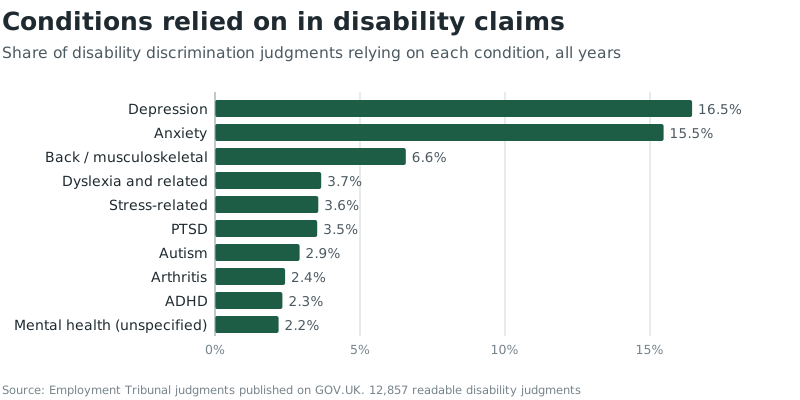
The page has two parts. The chart at the top shows how often each condition is relied on, as a share of disability judgments, either year by year or across all years. Below it is a search. You can pick a condition, filter by outcome and by the element that failed, and narrow by the year the claim was presented. Each result gives the case name, the outcome, a short quotation from the judgment on the disability point, and a link to the judgment itself.
Nearly 50 categories of condition are covered. Depression and anxiety are by far the most common, each relied on in around one disability judgment in six. Back and musculoskeletal conditions come next, then dyslexia and related conditions, stress, PTSD, autism, arthritis and ADHD.
How it was built and checked
A model running locally read each judgment and recorded the impairments relied on and the outcome for each. That first pass was useful but not reliable enough to publish as it stood, so every finding that the condition was rejected, accepted only as an impairment, or not decided was checked individually by a larger model against the text of the judgment. Findings that the condition was accepted or conceded were checked on a sample for each condition. Where the sample agreed less than nine times in ten, every finding for that condition was checked.
The result is not perfect. On whether a condition met the definition, the sample checks agreed in about 96% of cases. Whether disability was conceded or decided by the tribunal is less reliable, and was wrong in about one sampled finding in fifteen. Each result shows its quotation and links to the judgment, so the finding can be checked at source, and corrections are welcome.
What the judgments show
A few patterns stand out.
Stress is the hardest condition to establish. Where a respondent disputed disability, claimants relying on stress lost the point in 58% of cases, against 37% for depression and 38% for anxiety. Respondents also concede stress far less often: 28% of the time, against 47% for depression and 44% for anxiety. The reason is a familiar one. Tribunals distinguish a mental impairment from a reaction to difficult circumstances at work, a point made in J v DLA Piper UK LLP [2010] ICR 1052 (UKEAT/0263/09). In F George v PricewaterhouseCoopers Services Ltd (ET case no. 8001055/2024) the tribunal put it bluntly: “Burnout is not a condition or an impairment, but a consequence of a series of events or experiences, or a symptom of an impairment.” The claimant still succeeded on disability, but on the underlying trauma disorder, not the burnout.
Concession rates vary widely by condition. Across all conditions, respondents conceded disability in just under half of findings. For cancer it was 75%, which is unsurprising given that cancer is a disability from diagnosis. For stress it was 28%, and for mental health conditions described only in general terms it was 20%. That last group is also the most likely to go undecided.
The long-term requirement catches depression, not lifelong conditions. Where depression or anxiety was rejected, one of the most common reasons given was that the effects were not long-term: 96 of 329 rejections for depression, the most common reason, and 92 of 343 for anxiety, just ahead of failures on impairment (89). For ADHD, autism and dyslexia, not one of 112 rejections turned on the long-term requirement. Those claims failed mostly on whether an impairment was shown at all, or on whether its effects were substantial.
Deemed disabilities are almost never rejected. Under Schedule 1, paragraph 6 of the Equality Act 2010, cancer, HIV and multiple sclerosis are disabilities from diagnosis. Of 308 findings on those conditions, 9 were rejected, and none of them involved HIV. Where the tribunal gave a reason, it was that the claimant had not been diagnosed with cancer, for example because a tumour was benign or the tests showed no cancer. In the other four the judgment records the outcome without reasons. Three involved tumours, which may not have been cancerous, or not diagnosed as cancer at the relevant time. The fourth, an MS claim, gives no explanation at all. Without reasons it isn’t possible to say whether the tribunal considered the deeming provision and found it didn’t apply, or whether it was overlooked.
Across all conditions, claimants lost between roughly a third and two-fifths of disputed disability findings in each claim year from 2018 to 2025, with no clear trend.
Using it
The viewer is most useful for questions like these: how have tribunals treated a particular condition, how often is it disputed, and on which part of the test do claims based on it tend to fail? For a specific condition, the search will usually turn up judgments with comparable facts and show how the tribunal reasoned. It doesn’t replace reading the judgment, but it should make the right judgments easier to find.